If you see evil and you can stop it, but you decide not to, you have become a part of that evil.
Yusuf Akinyemi
Tayo was one of the most brilliant girls at secondary school. On each of her report cards, every teacher would always have something remarkable to say about her. She was an only child, and she made her parents’ life easier by showing them support. But before she could reach adulthood, her parents left the world. Her uncle from the North offered to be her guardian and take care of her.
Her uncle figured he couldn’t cater for her and his six children at the same time. He couldn’t even feed her or send her to school.
His long-time friend had been trying to marry her, but her uncle didn’t give in, at first. Uncle Gideon took a week to think about it and finally gave her hand in marriage to his friend. She was 17, an age where she could have been laying the foundation for the great things she might have achieved in her future.
Over the next several years, she gave birth to four children. She lived her life from hand to mouth. All her dreams were gone. She couldn’t afford to take care of her kids, exposing them in turn to the harsh realities of child labour.
Child labour, according to the International Labour Organization, is work that deprives children of their childhood, their potential and their dignity, and that is harmful to their physical and mental development.

Unfortunately, the decision to put a child into labour is usually a “last resort,” made because the guardians feel they don’t have a choice.
According to the story above, one cogent cause was poverty. Statistics have shown that about half of the Nigerian population live under the poverty threshold of $1 a day. There have been efforts to alleviate poverty, but the numbers keep increasing.
The second cause is early marriage, which is what Tayo experienced. And that brings us to the next point: illiteracy. Her uncle could only think to use her as a child labourer or marry her away, since his own lack of education wouldn’t let him see beyond that, to the skills she could have learned instead, just as a boy her age could have.
Low expectations and the death of parents can also play a role. When a child ends up with a guardian or relative rather than a parent, it often doesn’t end well.
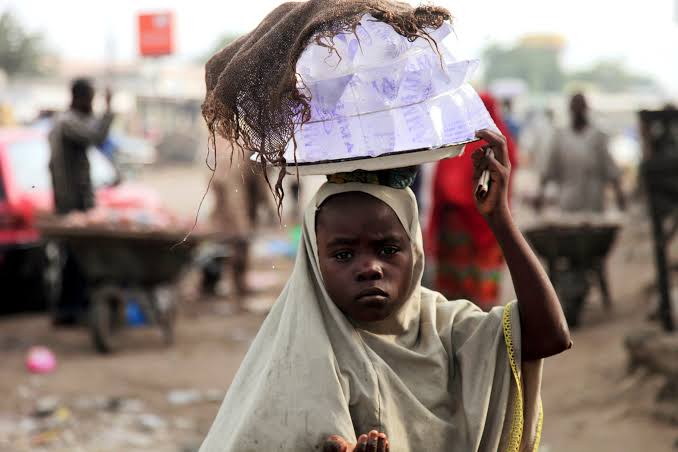
What are the consequences?
First, it damages a child’s self-esteem. Tayo’s kids couldn’t afford to go to school while they watched other children wear uniforms and run in at the sound of the school bell.
They’re denied their fundamental human rights (the law states that putting a child through labour is a crime) and are left exposed to manipulation on the street, and vulnerable to social vices such as kidnapping, rape and trafficking.
Health issues follow too: infections and diseases take hold when children can’t take care of themselves.
And the cycle of illiteracy repeats: without a change, they pass the same path on to their own children, who never get to hear anything about education or school.
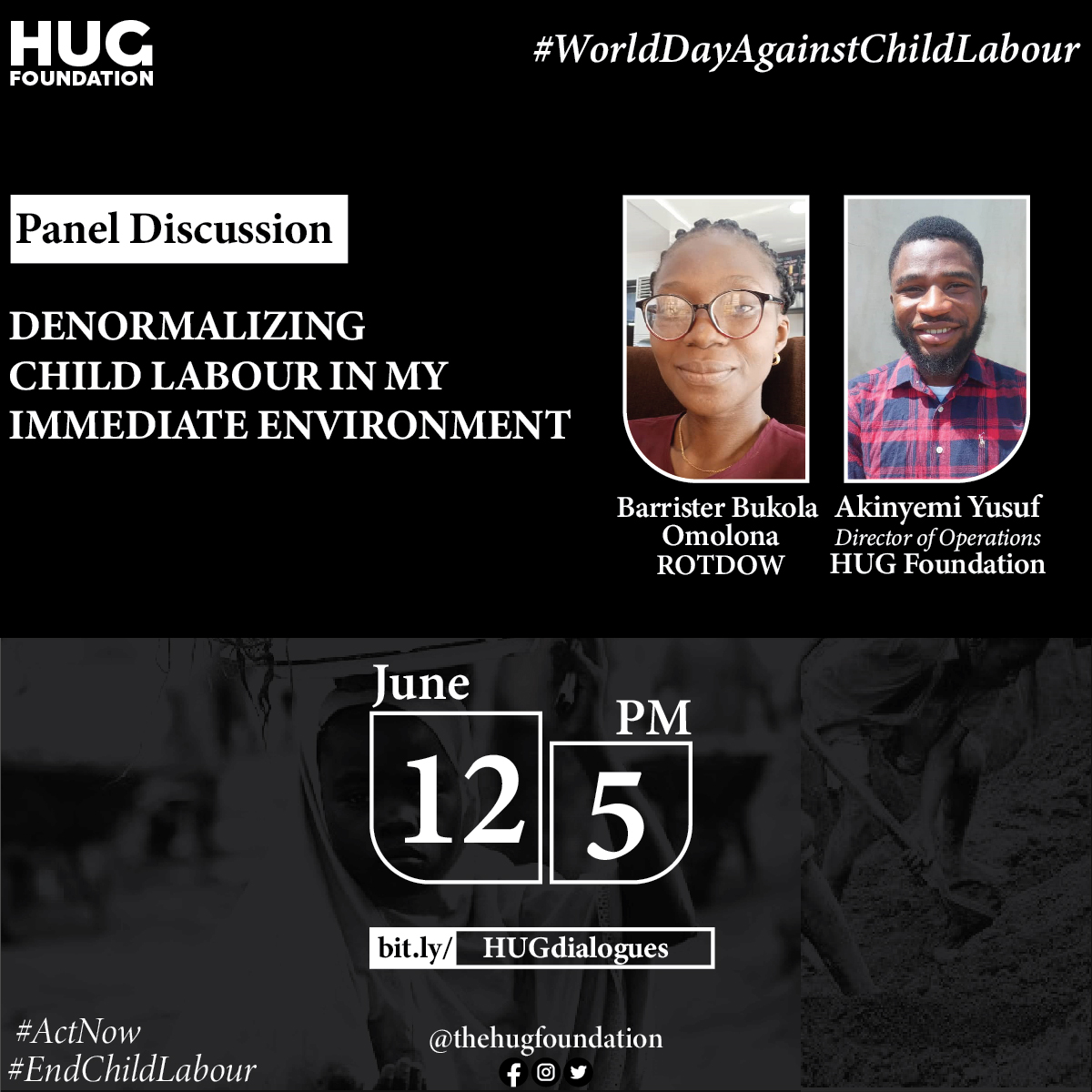
On the 12th of June, 2021, HUG Foundation hosted a panel discussion to commemorate World Day Against Child Labour. Some of the points established were:
- The effects of child labour on psychological health can be long lasting and devastating to a child’s future.
- Because the enforcers of Child Rights Law often need to be called on to do their jobs, it falls to individuals and non-governmental organisations to draw the world’s attention when we encounter these cases. If you see evil and you can stop it, but decide not to, you become a part of that evil.
- Sensitization about child rights should happen not just for parents and teachers, but for children too.
- Most importantly, only by understanding what actually drives child labour in a particular community can we find sustainable solutions.
HUG Foundation joins the rest of the world to stand against child labour.
Odetayo Tomiwa